
Modal Sosial Suku Arfak dalam Usahatani Padi Ladang di Kampung Guentuy Kabupaten Manokwari Papua Barat
Authors
-
Yolanda Holle
Program Studi Agribisnis, Universitas Papua, Manokwari
- Siti Halimatus Sadiyah
Program Studi Agribisnis, Universitas Papua, ManokwariKeywords:
arfak tribe, paddy fields, social network, social norms, trustAbstract
Exploring the potential of social capital as a social strength of society in developing farming becomes the central point of sustainable agricultural development. The Arfak tribe, a farming community, living in the Papua region, has only been introduced to the introduction of upland rice in their farming activities for approximately three years. The study to find the social capital strength of the Arfak Tribe in upland rice farming, the application of upland rice farming, and the relationship between social capital and the application of upland rice farming is the aim of this research. The research was conducted in Guentuy Village, a center for upland rice production from indigenous Papuan farmers. The number of respondents was 84 Arfak Tribe farmers who cultivate field rice. The survey method uses in-depth interviews and field observations of 84 farmers from the Arfak Tribe. Data were analyzed using descriptive statistical analysis and inferential statistics. The results showed that the social capital owned by the Arfak Tribe in upland rice farming included trust in family members, transmigration farmers, and village officials to cooperate, share experiences, work without pay, and provide village funds for upland rice farming. Social interaction between family members, transmigration farmers, and village officials in discussing field rice problems, borrowing equipment from each other, and collaborating is the social capital of the Arfak Tribe’s built-in social networks. The social capital of the Arfak Tribe is in the form of obedience to find sources of consumption, not forbidding farmers to consume rice. Therefore, it gives the Arfak Tribe an opportunity to learn upland rice farming. The study results concluded that the Arfak Tribe had not fully implemented the farming component. The test results show that the social network between members of farmer groups and village officials influences the Arfak Tribe’s belief in implementing field rice farming. Furthermore, the social norms of the Arfak Tribe, which do not prohibit farmers from consuming rice, provide opportunities for Arfak Tribe farmers to learn the seed preparation stage as the initial stage of implementing upland rice farming.
Downloads
Download data is not yet available.References
Aghajanian, A., Justino, P., & Tranchant, J.-P. (2020). Riots and social capital in urban India.
Anggaraini, O. , M. A. (2018). Penguatan Modal Sosial Berbasis Kelembagaan Lokal Masyarakat Pesisir Perspektif Gender di Kabupaten Bantul. JSEP, 11(2), 11–22.
Ataribaba, Y., Setiawan, I., & Noor, T. I. (2020). Pola Pergeseran Nilai Kearifan Lokal Sistem Ladang Berpindah Pada Masyarakat Arfak Change Of Patterns Local Value Of Shifting Cultivation In Arfak Communities. Mimbar Agribisnis, 6(2), 812–832.
Aziz, B. W., Kasnawi, M. T., & Sakaria, S. (2021). Modal Sosial Petani Dalam Peningkatan Produktifitas Pertanian Di Kelurahan Biraeng Kecamatan Minasate’ne Kabupaten Pangkep. Phinisi Integration Review, 4(1), 108–114.
Beding A.P; HL.Rohima S;Firdaus. (2016, May 31). Peningkatan Produktivitas Padi Gogo Di Lahan Kering Melalui Penerapan Pengelolaaan Tanaman Terpadu Di Kabupaten Sarmi. Prosiding Seminar Nasional Membangun Pertanian Modern Dan Inovatif Berkelanjutan Dalam Rangka Mendukung MEA.
Bulu, Y. G., Hariadi, S. S., Herianto, A. S., & Mudiyono, N. (2016). Pengaruh Modal Sosial dan Keterdedahan Informasi Inovasi Terhadap Tingkat Adopsi Inovasi Jagung di Kabupaten Lombok Timur Nusa Tenggara Barat. Jurnal Agro Ekonomi, 27(1), 1. https://doi.org/10.21082/jae.v27n1.2009.1-21
Garbarino, E., & Johnson, M. S. (1999). The Different Roles of Satisfaction, Trust, and Commitment in Customer Relationships. Journal of Marketing, 63(2), 70–87. https://doi.org/10.2307/1251946
Holle, Y., Windia, W., & I.GD.Setiawan Adi Putra, I. G. A. A. A. (2015). The Marine Tribe’s Social Capital in Developing Cultivation of Paddyfield Rice in Merauke Regency, Papua, Indonesia. Research on Humanities and Social Sciences, 5(6).
Inayah. (2012). Peranan Modal Sosial dalam Pembangunan. . 12(1): 43-49. Jurnal Pengembangan Humaniora, 12(1), 43–49.
Isir, Y., Hadi, S., & Hutabarat, M. (2016). Faktor-Faktor Yang Mempengaruhi Penggunaan Benih Tidak Bersertifikat Di Kampung Tanah Merah Distrik Warmare Kabupaten Manokwari (Studi Kasus Petani Padi Ladang (Oryza sativa) Suku Arfak). Jurnal Sosio Agri Papua, 5(1).
Kadushin, C. (2004). Some Basic Network Concepts and Propositions. Dalam: Understanding Social Network: Theories Concepts and Findings. University Press.
Kushandajani, Dr. (2006). Strategi Penguatan Modal Sosial Melalui Pendidikan (Belajar Dari Masyarakat Desa). Program Studi Pendidikan Ips Sekolah Pasca Sarjana Universitas Pendidikan Indonesia Bandung.
Lisawati, U., & Kristina, R. (2020). Pengaruh Brand Image @Gopayindonesia Terhadap Tingkat Kepercayaan Pelanggan. Pantarei, 4(1).
Magliola, V. (2005). The Concept of Social Capital in Classical Theories and Contemporary Research. N-7491Trondheim02/05, Trondheim, Centre for Rural Research.
Mawardi, M. J. (2007). Peranan Social Capital dalam Pemberdayaan Masyarakat. Jurnal Pengembangan Masyarakat Islam, 3(2), 5–14.
Mulyadi, Sugihen, B. G., Asngari, P. S., & Djoko Susanto, dan. (2009). Kearifan Lokal dan Hambatan Inovasi Pertanian Suku Pedalaman Arfak di Kabupaten Manokwari Papua Barat Local Wisdom and Agriculture Innovation Obstacle of The Upland Arfak Tribal Group in Manokwari Regent West Papua. In Jurnal Penyuluhan, Maret (Vol. 5, Issue 1).
Nofianti, T. (2020). Perubahan Sosial Komunitas Suku Arfak Kabupaten Pegunungan Arfak Papua Barat. Agribusiness Journal, 13(2), 95–107. https://doi.org/10.15408/aj.v13i2.13956
Ottebjer, L. (2005). Bourdieu, Coleman, and Putman on Social Capital. Application in Literature and Implications for Public Health Policy and Practice. Karolinska Institutet.
Parasmo, T. H. (2017). Jaringan Sosial Pedagang Barang Antik di Kota Surabaya (Studi Deskriptif Kualitatif Tentang Pedagang Klithikan Barang Antik di Jalan Bodri Kota Surabaya). Paradigma: Jurnal Online Mahasiswa S1 Sosiologi UNESA, 5(3).
Qianhong, F. (2004). Trust, Social Capital, and Organizational Effectiveness. The Virginia Polytechnic Institute State University.
Siisiäinen, M., & Martti. (2000). Two Concepts of Social Capital: Bourdieu vs. Putnam.
Sudarso Widya Prakoso Joyo Widakdo, D., Holik, A., & Nur Iska, L. (2021). Efek Usia dan Tingkat Pendidikan terhadap Kinerja Tenaga Bantu Penyuluh Pertanian. Jurnal Penyuluhan, 17(1), 52–59. https://doi.org/10.25015/17202131614
Ukkas, I., Studi, P., Sekolah, M., Ilmu, T., Muhammadiyah, E., & Abstrak, P. (2017). Faktor-Faktor Yang Mempengaruhi Produktivitas Tenaga Kerja Industri Kecilkota Palopo. In Journal of Islamic Education Management (Vol. 2, Issue Oktober).
Walgito, B. (2008). Pengantar Psikologi Umum. Andi Offset.
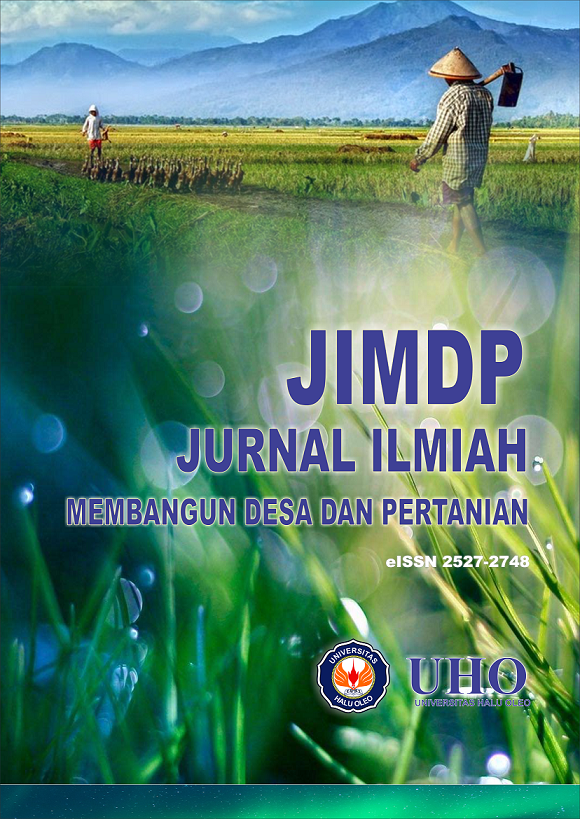

Published
2022-09-14How to Cite
Holle, Y., & Sadiyah, S. H. (2022). Modal Sosial Suku Arfak dalam Usahatani Padi Ladang di Kampung Guentuy Kabupaten Manokwari Papua Barat. Jurnal Ilmiah Membangun Desa Dan Pertanian, 7(5), 167–176. https://doi.org/10.37149/jimdp.v7i5.343Issue
Section
ArticlesDigital Object Identifierhttps://doi.org/10.37149/jimdp.v7i5.343Copyright & LicensingCopyright (c) 2022 Yolanda Holle, Siti Halimatus Sadiyah

This work is licensed under a Creative Commons Attribution-ShareAlike 4.0 International License.
Authors retain copyright and grant the journal the right of first publication with the work simultaneously licensed under a Creative Commons Attribution (CC-BY-SA) 4.0 License that allows others to share the work with an acknowledgment of the work’s authorship initial publication in this journal.
Make a Submission
Sinta IF
Chat WA

Uho44
Keywords
Current Issue
Information
- Siti Halimatus Sadiyah


Published by Jurusan Agribisnis Fakultas Pertanian Universitas Halu Oleo
© JIMDP, e-ISSN: 2527-2748 | DOI: Prefix 10.33772 and 10.37149 by Crossref
 This work is licensed under a Creative Commons Attribution-ShareAlike 4.0 International License.
