
Livelihood Risk Adaptation Among Local Maize Farmers in Guluk-Guluk Madura Indonesia (A PLS-SEM Approach)
Authors
-
Anisah
Madura University Indonesia https://orcid.org/0009-0006-1374-8917
- Cepryana Sathalica Widyananda
Madura University Indonesia https://orcid.org/0000-0001-5474-3713- Tirta Yoga
Tribhuwana Tunggadewi University Indonesia https://orcid.org/0009-0008-8983-0719Keywords:
adaptation strategy, local maize, PLS-SEMAbstract
Local maize serves as a vital source of both food security and household income across various regions of Indonesia, particularly in Sumenep, Madura. However, efforts to sustain agricultural livelihoods are increasingly challenged by a range of risks. One of the most pressing issues is the growing prevalence of hybrid maize cultivation in Madura, which has adversely affected local farmers who continue to grow traditional maize varieties to meet their subsistence needs. Given these challenges, farmers need to develop and implement strategic responses by leveraging their available livelihood assets in order to mitigate risks and adopt adaptation strategies suited to their specific context. This study aims to develop a risk management and adaptation framework for maize farmers in the Guluk-Guluk area of Madura, taking into account their livelihood assets. The research was conducted in Guluk-Guluk, a location purposively selected based on regional differences in maize productivity. The study took place from October 2023 to March 2024 and involved 51 local maize farmers selected via random sampling with a 1% margin of error. The study assessed several forms of farmers' resources, including labor capacity, material assets, community networks, environmental conditions, and economic means, along with their adjustment practices, such as diversifying activities and modifying planting timelines. Risk variables included technological and natural risks. Data were analyzed using the Partial Least Squares-Structural Equation Modeling (PLS-SEM) method. The findings indicate that the resources supporting farmers' livelihoods play a meaningful and beneficial role in shaping how corn growers in the area manage risks and adjust their practices. The findings also indicate that the most commonly adopted adaptation strategy is diversification. Technological risk emerged as the most significant risk faced by farmers, while financial capital was found to be the most influential asset in supporting risk response and adaptation efforts.
Downloads
Download data is not yet available.References
Achmad, B., Sanudin, Siarudin, M., Widiyanto, A., Diniyati, D., Sudomo, A., Hani, A., Fauziyah, E., Suhaendah, E., Widyaningsih, T. S., Handayani, W., Maharani, D., Suhartono, Palmolina, M., Swestiani, D., Budi Santoso Sulistiadi, H., Winara, A., Nur, Y. H., Diana, M., ... Ruswandi, A. (2022). Traditional Subsistence Farming of Smallholder Agroforestry Systems in Indonesia: A Review. Sustainability, 14(14), 8631. https://doi.org/10.3390/su14148631
Amzeri, A. (2018). Tinjauan Perkembangan Pertanian Jagung di Madura dan Alternatif Pengolahan Menjadi Biomaterial. Rekayasa, 11(1). https://doi.org/10.21107/rekayasa.v11i1.4127
Dang, X., Gao, S., Tao, R., Liu, G., Xia, Z., Fan, L., & Bi, W. (2020). Do environmental conservation programs contribute to sustainable livelihoods? Evidence from China's grain-for-green program in northern Shaanxi province. Science of the Total Environment, 719. https://doi.org/10.1016/j.scitotenv.2020.137436
Fathy, R. (2019). Modal Sosial: Konsep, Inklusivitas dan Pemberdayaan Masyarakat. Jurnal Pemikiran Sosiologi, 6(1). https://doi.org/10.22146/jps.v6i1.47463
García de Jalón, S., Iglesias, A., & Neumann, M. B. (2018). Responses of sub-Saharan smallholders to climate change: Strategies and drivers of adaptation. Environmental Science and Policy, 90. https://doi.org/10.1016/j.envsci.2018.09.013
Hair, J. F., Jr., Hult, G. T. M., Ringle, C. M., & Sarstedt, M. (2021). A primer on partial least squares structural equations modeling (PLS-SEM). Sage Publications. Journal of Tourism Research, 6(2).
Hasna, M., & Supyandi, D. (2021). Partisipasi Petani Dalam Program Pengembangan Jagung Hibrida (Suatu Kasus Pada Kelompoktani Di Desa Mulyasari Kecamatan Mande Kabupaten Cianjur). Mimbar Agribisnis: Jurnal Pemikiran Masyarakat Ilmiah Berwawasan Agribisnis, 7(1). https://doi.org/10.25157/ma.v7i1.4555
Heryanto, A. Y., Kristanti, N. E., & Widodo, K. H. (2024). An Analysis of Logistic Cost Structure in Corn Commodity Supply Chain (Zea Mays L) in East Java Using Activity-Based Costing (ABC) Method. Emerging Advances in Integrated Technology, 5(2), 45–52. https://doi.org/https://doi.org/10.30880/emait.2024.05.02.004
Ibrahim, A. Z., Hassan, K. H., Kamaruddin, R., & Anuar, A. R. (2018). The Level of Livelihood Assets Ownership Among Vulnerability Groups in East Coast of Malaysia. European Journal of Sustainable Development, 7(3). https://doi.org/10.14207/ejsd.2018.v7n3p157
Kamaruddin, R., & Baharuddin, A. H. (2015). The importance of good aquaculture practices in improving fish farmers' income: A case of Malaysia. International Journal of Social Economics, 42(12). https://doi.org/10.1108/IJSE-02-2014-0028
Kasim, Y., Zubir Ibrahim, A., Binti, B., Din, H., Shafie, G., & School Of Government, G. (2017). Understanding the Effect of Access To Livelihood Assets and Government Intervention on Poverty Reduction: A Partial Least Squares Approach. International Journal of Emerging Trends in Engineering and Development Issue, 7(7), 123–138. https://doi.org/https://doi.org/10.17632/IJETED/JULY2017/0011
Kock, N. (2018). Minimum sample size estimation in PLS-SEM: An application in tourism and hospitality research. In Applying Partial Least Squares in Tourism and Hospitality Research. https://doi.org/10.1108/978-1-78756-699-620181001
Kock, N., & Hadaya, P. (2018). Minimum sample size estimation in PLS-SEM: The inverse square root and gamma-exponential methods. Information Systems Journal, 28(1). https://doi.org/10.1111/isj.12131
Kuang, F., Jin, J., He, R., Ning, J., & Wan, X. (2020). Farmers' livelihood risks, livelihood assets, and adaptation strategies in Rugao City, China. Journal of Environmental Management, 264. https://doi.org/10.1016/j.jenvman.2020.110463
Liu, Z., Chen, Q., & Xie, H. (2018). Influence of farmers' livelihood assets on livelihood strategies in the western mountainous area of China. Sustainability (Switzerland), 10(3). https://doi.org/10.3390/su10030875
Lun, R., Liu, W., Li, G., & Luo, Q. (2024). Does Digital Agricultural Technology Extension Service Enhance Sustainable Food Production? Evidence from Maize Farmers in China. Agriculture (Switzerland), 14(2). https://doi.org/10.3390/agriculture14020292
Ma, J., Zhang, J., Li, L., Zeng, Z., Sun, J., Zhou, Q. (Bill), & Zhang, Y. (2018). Study on livelihood asset-based spatial differentiation of income in natural tourism communities. Sustainability (Switzerland), 10(2). https://doi.org/10.3390/su10020353
Marliati. (2020). Factors influencing the entrepreneurial behavior of street vendors (A case in Pekanbaru City, Riau Province). Agraris, 6(2). https://doi.org/10.18196/agr.6297
Parmawati, R., Soemarno, S., Maryunani, M., & Kurnianto, A. S. (2018). Analysis Of Poverty In Forest Surrounding Communities By Sustainable Livelihood Approach. Jurnal Antropologi: Isu-Isu Sosial Budaya, 20(1). https://doi.org/10.25077/jantro.v20.n1.p1-15.2018
Paul, S., Das, T. K., Pharung, R., Ray, S., Mridha, N., Kalita, N., Ralte, V., Borthakur, S., Burman, R. R., Tripathi, A. K., & Singh, A. K. (2020). Development of an indicator-based composite measure to assess livelihood sustainability of shifting cultivation-dependent ethnic minorities in the disadvantaged Northeastern region of India. Ecological Indicators, 110. https://doi.org/10.1016/j.ecolind.2019.105934
Peng, L., Tan, J., Deng, W., & Liu, Y. (2017). Understanding the resilience of different farming strategies in coping with geo-hazards: A case study in Chongqing, China. International Journal of Environmental Research and Public Health, 4(7), 123–138. https://doi.org/https://doi.org/10.17632/IJETED/JULY2017/0011
Safruddin, S., Sitopu, J. W., Manurung, A. A., Satria, I., & Wanto, A. (2023). Pengelompokkan Produksi Tanaman Jagung di Sumatera Utara Menggunakan Algoritma K-Medoids. JURNAL MEDIA INFORMATIKA BUDIDARMA, 7(1). https://doi.org/10.30865/mib.v7i1.5562
Salsadyra, V. D., Nugroho, T. R. D. A., & Sugiarti, T. (2022). Female Farmworkers' Participation in the Cultivation of Madurese Local Maize at Pakaan Laok Village. Agriecobis : Journal of Agricultural Socioeconomics and Business, 5(02). https://doi.org/10.22219/agriecobis.v5i02.20311
Sedi, M., Akinola, A. A., Obunyali, C. O., Adebayo, M. A., Muungani, D., Mazambani, I., & Oikeh, S. O. (2024). Hybrid Maize Adoption Determinants in Northern Nigeria : A Gendered Perspective. International Journal of Agriculture and Technology, 4(1), 1–9. https://doi.org/https://doi.org/10.33425/2770-2928.1021
Shinbrot, X. A., Jones, K. W., Rivera-Castañeda, A., López-Báez, W., & Ojima, D. S. (2019). Smallholder Farmer Adoption of Climate-Related Adaptation Strategies: The Importance of Vulnerability Context, Livelihood Assets, and Climate Perceptions. Environmental Management, 63(5). https://doi.org/10.1007/s00267-019-01152-z
Solimun, Fernandes, A. A. R., & Nurjannah. (2017). Metode Statistika Multivariat Pemodelan Persamaan Struktural (SEM) Pendekatan WarpPLS. In UB Press (Cetakan Ke). UB Press. https://books.google.co.id
Su, Y., Zhang, S., Li, Y., & Yu, H. (2024). How does social capital promote consumer participation in food safety governance? Evidence from online food consumers in China. Humanities and Social Sciences Communications, 11(1). https://doi.org/10.1057/s41599-024-02890-0
Sulemana, M., Malongza, B. F. I., & Abdulai, M. (2019). Assessment of the Livelihood Empowerment Against Poverty programme in Karaga district, Ghana. Development in Practice, 29(4). https://doi.org/10.1080/09614524.2018.1551859
Syahrial, R., & Susanto, H. (2024). A Strategic Model To Fulfill The Food Security of Farming Families Who Maintain The Culture of Growing Local Madurese Maize. Agricultural Science, 8(1), 93–111. https://doi.org/https://doi.org/10.55173/agriscience.v8i1.153
Tripathi, A., Sardar, S., & Shyam, H. S. (2023). Hybrid crops, income, and food security of smallholder families: Empirical evidence from poor states of India. Technological Forecasting and Social Change, 191. https://doi.org/10.1016/j.techfore.2023.122532
Turasih, & M Kolopaking, L. (2016). Strategi Adaptasi Perubahan Iklim Pada Petani Dataran Tinggi (Studi Petani di Dataran Tinggi Dieng, Kabupaten Banjarnegara). Sodality: Jurnal Sosiologi Pedesaan, 4(1). https://doi.org/10.22500/sodality.v4i1.14408
Udoh, E. J., Akpan, S. B., & Uko, E. F. (2017). Assessment of Sustainable Livelihood Assets of Farming Households in Akwa Ibom State, Nigeria. Journal of Sustainable Development, 10(4). https://doi.org/10.5539/jsd.v10n4p83
Visković, J., Dunđerski, D., Adamović, B., Jaćimović, G., Latković, D., & Vojnović, Đ. (2024). Toward an Environmentally Friendly Future: An Overview of Biofuels from Corn and Potential Alternatives in Hemp and Cucurbits. Agronomy, 14(6). https://doi.org/10.3390/agronomy14061195
Wati, L. N. (2018). Metodologi Penelitian Terapan, Aplikasi SPSS, EVIEWS, Smart PLS dan AMOS. Pustaka Amri.
Windra sukma, K. perdana. (2018). Pertumbuhan dan Produksi Jagung Lokal, Hibrida dan Komposit Di Pamekasan Madura. Jurnal Agrosains: Karya Kreatif Dan Inovatif, 4(2). https://doi.org/10.31102/agrosains.2017.4.2.34-38
Wong. (2019). Mastering Partial Least Squares Structural Equation Modeling (PLS-SEM) with SmartPLS in 38 Hours. Syria Studies, 7(1).
You, H., Hu, X., Bie, C., & Zhou, D. (2019). Impact of livelihood assets on farmland-transferred households' willingness to urbanize and policy implications for farmland transfer: Evidence from Zhejiang, China. Discrete Dynamics in Nature and Society, 2019. https://doi.org/10.1155/2019/9631701
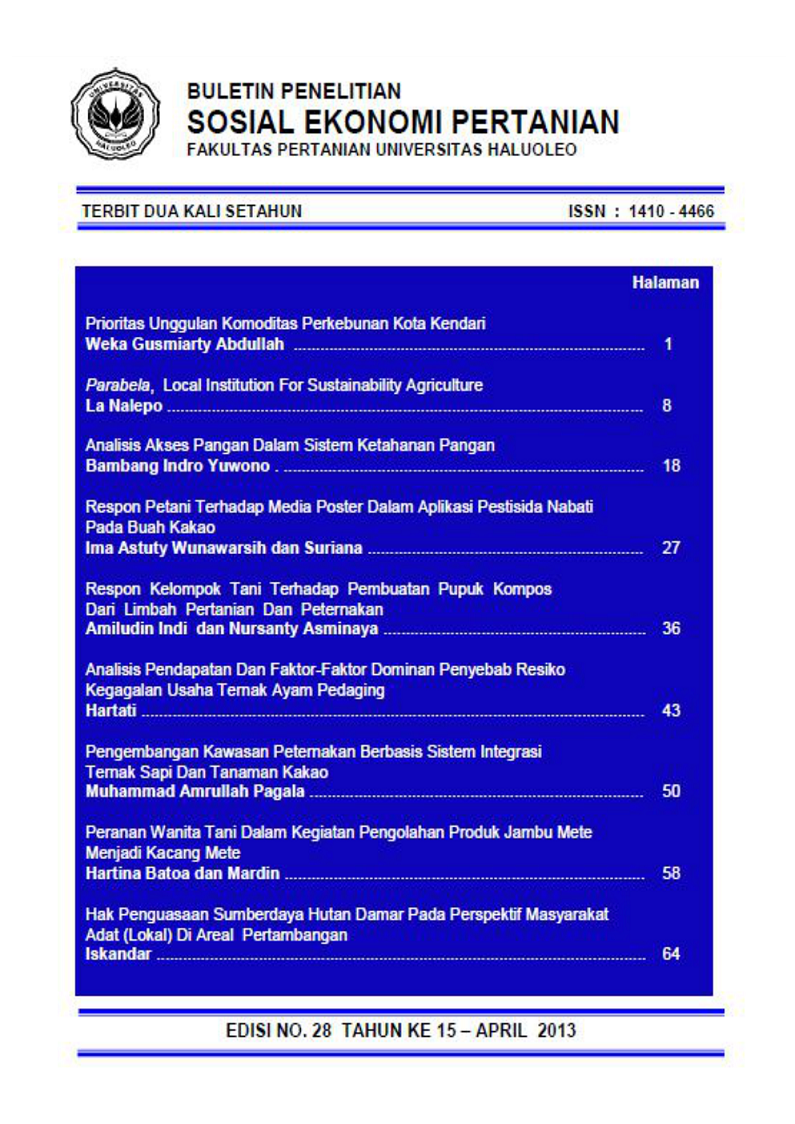

Published
2025-11-24How to Cite
Anisah, A., Widyananda, C. S., & Yoga, T. (2025). Livelihood Risk Adaptation Among Local Maize Farmers in Guluk-Guluk Madura Indonesia (A PLS-SEM Approach). Buletin Penelitian Sosial Ekonomi Pertanian Fakultas Pertanian Universitas Haluoleo, 27(2), 109–118. https://doi.org/10.37149/bpsosek.v27i2.1831Issue
Section
ArticlesDigital Object Identifierhttps://doi.org/10.37149/bpsosek.v27i2.1831Copyright & LicensingCopyright (c) 2025 Anisah, Cepryana Sathalica Widyananda, Tirta Yoga

This work is licensed under a Creative Commons Attribution-ShareAlike 4.0 International License.
Authors retain copyright and grant the journal the right of first publication with the work simultaneously licensed under a Creative Commons Attribution (CC-BY-SA) 4.0 License that allows others to share the work with an acknowledgment of the work’s authorship initial publication in this journal.
Most read articles by the same author(s)
- Tirta Yoga, Arief Joko Saputro, Yohana Anggriani, Improving Rice Farming Efficiency: Insights from Stochastic Frontier Analysis in Ponorogo District , Buletin Penelitian Sosial Ekonomi Pertanian Fakultas Pertanian Universitas Haluoleo: Vol. 26 No. 2 (2024)
Make a Submission
Sinta IF
Chat WA

Uho44
Keywords
Current Issue
Information
Published by Jurusan Agribisnis Fakultas Pertanian Universitas Halu Oleo
© BPSosek, p-ISSN: 1410-4466 | e-ISSN: 2656-4270 | DOI: Prefix 10.33772 and 10.37149 by Crossref
 This work is licensed under a Creative Commons Attribution-ShareAlike 4.0 International License.
- Cepryana Sathalica Widyananda


