
The Local Wisdom Existence of Swidden Agriculture on Wawonii Island
Authors
-
Sitti Rosmalah
Department of Agribusiness Universitas Muhammadiyah Kendari
- Ahmad Muhlis Nuryadi
Department of Agribusiness Universitas Muhammadiyah Kendari- Samsul Alam Fyka
Department of Agribusiness Halu Oleo University KendariKeywords:
existence, local wisdom, swidden agriculture, Wawonii IslandAbstract
The study assessed the existence of the local wisdom of swidden agriculture on Wawonii Island. Specifically, it identified the farming patterns in Wawonii Island and analyzed the local wisdom of swidden agriculture in Wawonii Island. Purposive sampling procedures were used to get an informant sample, and proportionate random sampling was used to get a farmers' sample. Informants in this study came from community leaders, village staff, and the agriculture and forestry service district. Konawe Islands and extension workers, while the sample of farmers totalling 30 people was taken proportionally from each sub-district on Wawonii Island. Data were collected using a structured interview schedule and summarized with percentages and means. The analytical method used is descriptive qualitative analysis. Results showed the local wisdom of the farmers who used to be slowly fading away. Farmers no longer carry out the tradition of land clearing as before due to limited land. The addition of chemical inputs also slowly began to be carried out because of the short period of resting land. The people of Wawonii Island manage their fields using two agricultural patterns carried out for generations: mixed cropping and monoculture. The existence of local wisdom of field farmers has decreased. The study recommended that the government provides policies that support the preservation of the local wisdom of the people that contribute positively to the balance of forest and land resources therein.
Downloads
Download data is not yet available.References
Asysyifa. (2009). Karakteristik Sistem Perladangan Suku Dayak Meratus Kecamatan Loksado Kalimantan Selatan. Hutan Tropis Borneo, 25(25), 98–109. https://ppjp.ulm.ac.id/journal/index.php/jht
Ataribaba Yuliana, Setiawan Iwan, & Noor Trisna Insan. (2020). Pola Pergeseran Nilai Kearifan Lokal Sistem Ladang Berpindah pada Masyarakat Arfak. Mimbar Agribisnis Jurnal Pemikiran Masyarakat Ilmiah Berwawasan Agribisnis., 6(2), 812–832. http://dx.doi.org/10.25157/ma.v6i2.3570
Evizal, R. (2015). Etno-agronomi Pengelolaan Perkebunan Kopi di Sumberjaya Kabupaten Lampung Barat. Agrotrop: Journal on Agriculture Science, 3(2), 1–12. https://ojs.unud.ac.id/index.php/agrotrop/article/view/15195
Fox, J., Vogler, J. B., Sen, O. L., Giambelluca, T. W., & Ziegler, A. D. (2012). Simulating land-cover change in Montane mainland southeast Asia. Environmental Management, 49(5), 968–979. https://doi.org/10.1007/s00267-012-9828-3
Hujairin Muhammad, Ahwan Ismadi, & Tatan Kustana. (2017). Revitalisasi Kearifan Lokal Suku Arfak di Papua Barat Dalam Rangka Mendukung Ketahanan Pangan Wilayah - Penelusuran Google. Jurnal Pemikiran Dan Penelitian Manajemen Pertahanan, 3(1), 53–77. https://jurnalprodi.idu.ac.id/index.php/MP/article/view/59
Li, P., Feng, Z., Jiang, L., Liao, C., & Zhang, J. (2014). A review of swidden agriculture in Southeast Asia. Remote Sensing, 6(2), 1654–1683. https://doi.org/10.3390/rs6021654
Mertz, O., Leisz, S. J., Heinimann, A., Rerkasem, K., Thiha, Dressler, W., Pham, V. C., Vu, K. C., Schmidt-Vogt, D., Colfer, C. J. P., Epprecht, M., Padoch, C., & Potter, L. (2009). Who counts? Demography of swidden cultivators in Southeast Asia. Human Ecology, 37(3), 281–289. https://doi.org/10.1007/s10745-009-9249-y
Mukul, S. A., & Herbohn, J. (2016). The impacts of shifting cultivation on secondary forests dynamics in tropics: A synthesis of the key findings and spatiotemporal distribution of research. Environmental Science and Policy, 55(March 2020), 167–177. https://doi.org/10.1016/j.envsci.2015.10.005
Mulyoutami, E., Noordwijk, M. van, Sakuntaladewi, N., & Agus, F. (2010). Perubahan Pola Perladangan. website: http://worldagroforestry.org/sea
Ostrom, E. (2007). A diagnostic approach for going beyond panaceas. Proceedings of the National Academy of Sciences of the United States of America, 104(39), 15181–15187. https://doi.org/10.1073/pnas.0702288104
Pascual, U. (2005). Land use intensification potential in slash-and-burn farming through improvements in technical efficiency. Ecological Economics, 52(4), 497–511. https://doi.org/10.1016/j.ecolecon.2004.09.012
Pauw, E. De. (1995). Plant-Soil Interactions at Low pH: Principles and Management. Plant-Soil Interactions at Low PH: Principles and Management, June. https://doi.org/10.1007/978-94-011-0221-6
Rifki, M. (2017). Ladang Berpindah dan Model Pengembangan Pangan Indonesia. Seminar Nasional Inovasi Dan Aplikasi Teknologi 2017, February, E22.1-E22.7.
Rosmalah, S., Widayati, W., & Sidu, D. (2019). Existence of Swidden Agriculture on a Small Island. The Ijes, 68–75. https://doi.org/10.9790/1813-0803016875
Silvi, Lumangkun, A., & Wardenaar, E. (2017). Kearifan Lokal Masyarakat Dalam Kegiatan Ladang Berpindah Di Dusun Laek Desa Bengkilu Kecamatan Tujuh Belas Kabupaten Bengkayang. Jurnal Hutan Lestari. http://dx.doi.org/10.26418/jhl.v5i4.23017
Tanzito, G., Ibanda, P. A., Talaguma, R., & Lusanga, N. M. (2020). Slash-and-burn agriculture, the major cropping system in the region of Faradje in the Democratic Republic of Congo: Ecological and socio-economic consequences. Journal of Development and Agricultural Economics, 12(1), 25–36. https://doi.org/10.5897/jdae2019.1140
Thrupp, L. A., Hecht, S., Browder, J. O., & World Resources Institute. (1997). The diversity and dynamics of shifting cultivation : myths, realities, and policy implications (Issue September).
van Vliet, N., Mertz, O., Heinimann, A., Langanke, T., Pascual, U., Schmook, B., Adams, C., Schmidt-Vogt, D., Messerli, P., Leisz, S., Castella, J. C., Jørgensen, L., Birch-Thomsen, T., Hett, C., Bruun, T. B., Ickowitz, A., Vu, K. C., Yasuyuki, K., Fox, J., … Ziegler, A. D. (2012). Trends, drivers and impacts of changes in swidden cultivation in tropical forest-agriculture frontiers: A global assessment. Global Environmental Change, 22(2), 418–429. https://doi.org/10.1016/j.gloenvcha.2011.10.009
Yandi, J., M, I. A., & Idham, M. (2019). Permasalahan Sosial Pada Masyarakat Ladang Berpindah Akibat Perkebunan Kelapa Sawit Di Desa Sempurna Kecamatan Sungai Laur Kabupaten Ketapang. Jurnal Hutan Lestari, 7(1), 256–264. https://doi.org/10.26418/jhl.v7i1.31663
Yusran, J., Yonariza, Y., Elfindri, E., & Mahdi, M. (2020). Kebangkitan Ladang Berpindah Di Nagari Silayang Kecamatan Mapattunggul Selatan Kabupaten Pasaman Provinsi Sumatera Barat. SOCA: Jurnal Sosial, Ekonomi Pertanian, 14(1), 1. https://doi.org/10.24843/soca.2020.v14.i01.p01
Zenda Za Begani Arthur-Josué, N., Faustino, O.-M., & Godfrey, M. (2020). Subsistence Agriculture and its Effect on Smallholder Farmers’ Socioeconomic Status in South Kivu Province, Democratic Republic of Congo. Journal of Environmental Science and Public Health, 04(04), 380–389. https://doi.org/10.26502/jesph.96120108
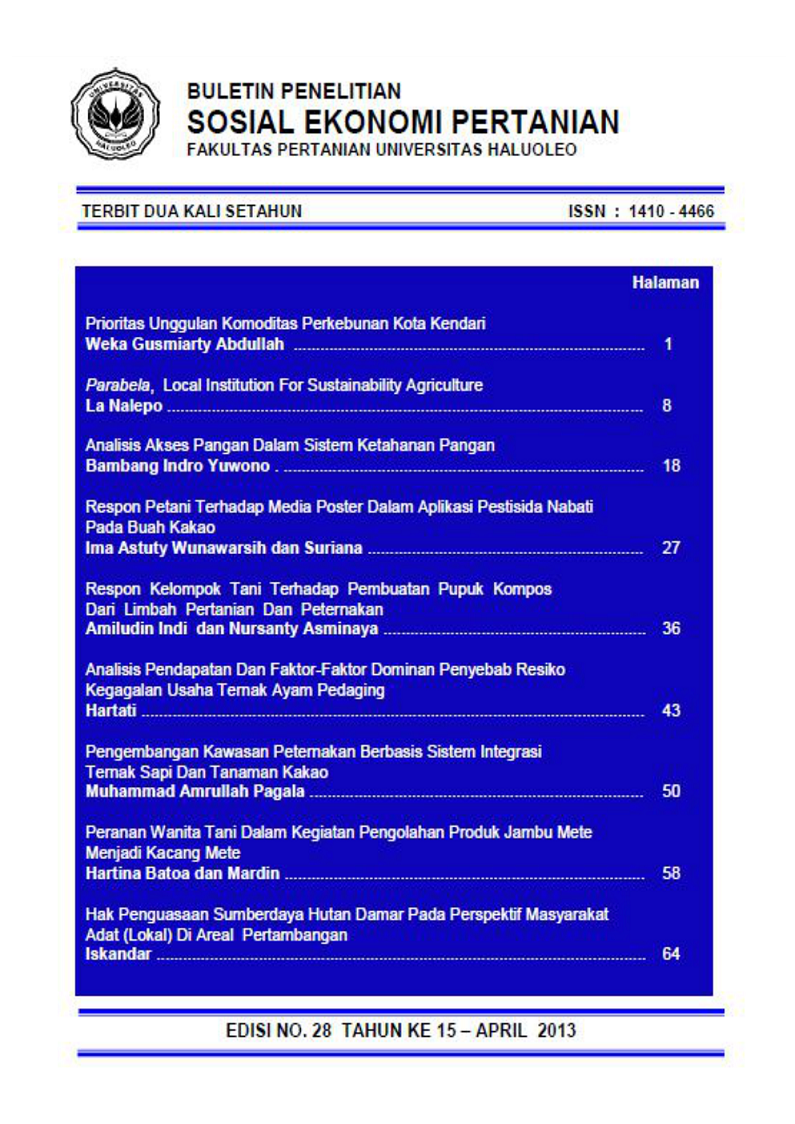

Published
2023-03-28How to Cite
Rosmalah, S., Nuryadi, A. M., & Fyka, S. A. (2023). The Local Wisdom Existence of Swidden Agriculture on Wawonii Island . Buletin Penelitian Sosial Ekonomi Pertanian Fakultas Pertanian Universitas Haluoleo, 24(2), 134–141. https://doi.org/10.37149/bpsosek.v24i2.419Issue
Section
ArticlesDigital Object Identifierhttps://doi.org/10.37149/bpsosek.v24i2.419Copyright & LicensingCopyright (c) 2022 Sitti Rosmalah, Ahmad Muhlis Nuryadi, Samsul Alam Fyka

This work is licensed under a Creative Commons Attribution-ShareAlike 4.0 International License.
Authors retain copyright and grant the journal the right of first publication with the work simultaneously licensed under a Creative Commons Attribution (CC-BY-SA) 4.0 License that allows others to share the work with an acknowledgment of the work’s authorship initial publication in this journal.
Most read articles by the same author(s)
- Aynul Izati, Ilma Sarimustaqiyma Rianse, Samsul Alam Fyka, The Oyster Mushroom Business Development Strategy In Anduonohu Sub-District Poasia District Kendari City , Buletin Penelitian Sosial Ekonomi Pertanian Fakultas Pertanian Universitas Haluoleo: Vol. 25 No. 1 (2023)
Make a Submission
Sinta IF
Chat WA

Uho44
Keywords
Current Issue
Information
Published by Jurusan Agribisnis Fakultas Pertanian Universitas Halu Oleo
© BPSosek, p-ISSN: 1410-4466 | e-ISSN: 2656-4270 | DOI: Prefix 10.33772 and 10.37149 by Crossref
 This work is licensed under a Creative Commons Attribution-ShareAlike 4.0 International License.
- Ahmad Muhlis Nuryadi


